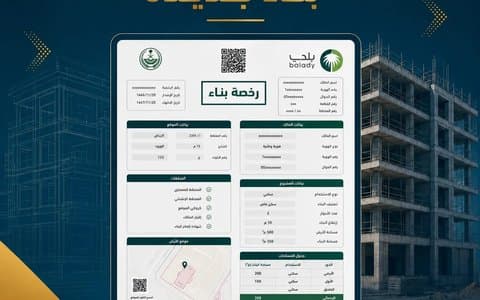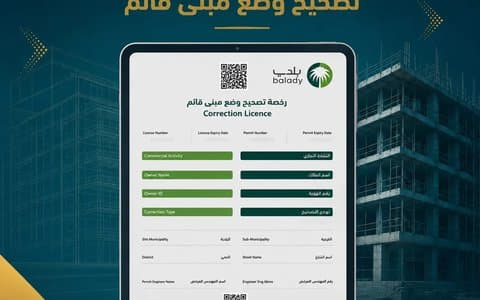


The building compliance certificate is an electronic Balady service confirming that a building meets the ministry's approved requirements for reducing visual distortion in commercial and residential buildings and improving the urban landscape. It is different from the occupancy certificate, which proves the building was completed according to its permit; compliance is about what people see of the building: facades, signs, fences and elements added to the roof and outer walls.
This guide explains when the certificate is issued, how it differs from occupancy, the requirements, the steps, and the elements that most often block compliance and how to fix them before applying.
What Is the Purpose of the Compliance Certificate?
The service is part of the ministry's efforts to tackle visual distortion: elements that harm the look of the street and the city, such as worn-out facades, exposed services, random signs, and irregular shades and fences. The certificate documents that the building meets the required level of these requirements.
When Is the Compliance Certificate Issued?
- Automatically once an occupancy certificate application is completed and the invoice paid, without a separate request.
- By a separate request for existing buildings through the Balady app, the key route for older buildings that never went through modern occupancy procedures.
Compliance Certificate vs. Occupancy Certificate
| Occupancy certificate | Building compliance certificate | |
|---|---|---|
| What does it prove? | The building is complete according to its permit and ready for use | The building meets urban landscape requirements and limits visual distortion |
| When is it requested? | After construction is complete | Automatically after occupancy, or by a separate request for an existing building |
| What is the basis? | A building permit issued 6 months or more ago | A valid building permit or an ownership document |
| What does it focus on? | Conformity with drawings and safety | The exterior appearance and visible elements |
To understand the differences with other certificates too: Occupancy vs. compliance vs. safety certificates.
Requirements for the Building Compliance Certificate
- A valid building permit or the property's ownership document.
- Applying through Balady by the beneficiary or through an authorised engineering office.
- If an agent applies, the owner must first add the power of attorney through municipal authorisations.
- Clear, recent photos of the building's exterior showing the condition of the facades and visible elements.
Steps for an Existing Building (via the Balady App)
- Log in to the Balady app and open the building compliance certificate service.
- Choose to apply yourself or through an authorised party, and enter the permit or ownership document details.
- Locate the building on the map.
- Complete the compliance items and attach the documents.
- Accept the declaration and undertaking, then submit.
Elements That Commonly Block Compliance
| Element | Common problem | Fix |
|---|---|---|
| Facades | Cracks, peeling paint, damaged cladding | Repair and refinish the facade |
| Exposed services | Pipes, cables and AC units randomly fixed to the facade | Reorganise or conceal them with architectural solutions |
| Shop signs | Signs of conflicting sizes and positions | Standardise their positions and sizes per the requirements |
| Roofs | Debris, irregular tanks or annexes | Clean up, reorganise and screen elements |
| Shades and fences | Non-compliant shades or worn-out fences | Remove or replace with compliant elements |
Some of these fixes are simple; others need a permit such as restoration or component modification. Read: Which permit does an existing building need? and Car shade violations.
Who Is Responsible After the Building Is Leased?
A frequent question on Balady: does responsibility for the compliance certificate pass to the tenant? The detailed answer is in the service FAQ; the practical rule is to set this out clearly in the lease, especially if the tenant will add signs or elements to the facade.
Tips Before Applying
- Inspect the facades from the street as passers-by see them, not from inside the building.
- Agree with commercial tenants on standardising signs before applying.
- Fix non-compliant elements first, then take the photos; old photos do not reflect the actual condition.
- If the facade needs redesigning, adopt a complete architectural solution rather than patching.
Frequently Asked Questions
Do I need a separate request if I received an occupancy certificate?
No, the compliance certificate is issued automatically once the occupancy application is completed and the invoice paid.
Can it be issued for a building without a building permit?
The service accepts a valid building permit or the property's ownership document.
Who submits the application?
The owner, an authorised engineering office, or an agent after the power of attorney is added in municipal authorisations.
Is the certificate required for residential buildings?
The service covers residential and commercial buildings as part of efforts to reduce visual distortion.
What if the facade needs major restoration?
You may need a restoration or component modification permit before applying, depending on the work.
Related Guides
- The occupancy certificate: a complete guide
- Fines for non-compliant buildings
- Modifying building components
How Abak Engineering Consultancy Helps
If your building needs work on its facades or visible elements before compliance, Abak's architectural design team can prepare the solution and drawings and handle the application as an authorised office. Learn more about our Occupancy Certificate service. Contact us.
Regulatory information is based on the Balady platform and the Ministry of Municipalities and Housing, and procedures may be updated by the competent authority. Last reviewed: October 2026.