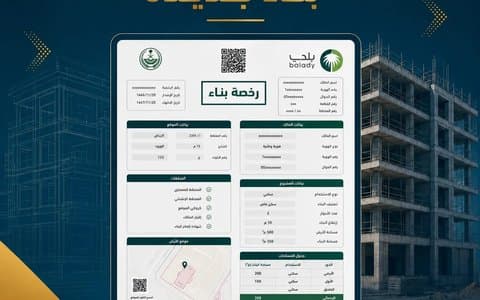

An existing building that has stood for years without a permit? Or one with a permit, but what is on the ground differs from it: an extra floor, a rooftop annex, shops opened in a residential facade? These cases are very common, and the problem only shows up at sale, financing, issuing a commercial license for a tenant, or applying for an occupancy certificate. The official solution is the existing building status correction permit via the Balady platform.
In this guide we explain when you need it, how it differs from similar permits, its official requirements and steps as on the Ministry of Municipalities and Housing service page, how fines are calculated, and what the engineering office actually prepares.
What Is an Existing Building Status Correction Permit?
The existing building status correction permit is an electronic Balady service that allows the owner of a building that already exists to document it officially: whether no permit was ever issued, or a permit was issued but the current condition differs from it. The engineering office prepares the drawings, the municipality calculates any fines, and the permit is issued after payment.
When Do You Need Existing Building Status Correction?
- An old building with no permit at all. Balady states that old buildings without permits can apply for this service after issuing a survey decision for the same purpose.
- A building that differs from its permit: an extra floor or annex, or a change in use or areas.
- An old paper permit whose data cannot be retrieved. First read: Your old permit does not appear on Balady?
- A tenant needs a commercial license and the owner has no building permit. According to Balady, the owner applies for status correction, then the permit is attached to the commercial license application.
- An owner wants to modify components of an old building without a permit. Modification is not possible directly; it starts with status correction.
Status Correction or Another Permit? A Quick Comparison
| Service | When it is used | Note |
|---|---|---|
| Existing building status correction | An existing building with no permit, or different from its permit | Fines, if any, are calculated within the application |
| Adding and modifying building components | A licensed building where you want to add, modify or remove components | Requires a valid, correct permit |
| Restoration permit | Restoration works in a licensed building | Submitted based on the building permit |
| Correcting building permit data | The permit is correct but its data on Balady is wrong (permits migrated from the municipality) | Unrelated to the building's physical condition |
| Transfer of building permit ownership | The permit is in the previous owner's name | Submitted before the permit expires |
| Government building status correction | The building is owned by a government entity | A separate service that requires a technical report |
Detailed decision guide: Status correction, modification or restoration?
Requirements for the Existing Building Status Correction Permit
The official service page lists three core requirements:
- Contracting with an engineering office, which completes the data and prepares the required drawings.
- Paying the service fees, plus any calculated fines.
- A survey decision for the purpose of correcting an existing building's status, or a previous building permit on which the application is based.
In practice, the office also needs an updated electronic title deed, an accurate field survey of the building, and sometimes a technical report on its structural condition. To obtain the survey decision, see surveying services.
Important: the survey decision must be for the same purpose (existing building status correction). A survey decision issued for new construction is not enough, and the purpose can be changed through the survey decision amendment service before a permit is issued on it.
Steps to Get the Existing Building Status Correction Permit
- Log in to Balady through the National Single Sign-On, choose construction license services, then "Issuing a Permit to Rectify Existing Building Status".
- Read the instructions, confirm the information is correct, and verify your mobile number.
- Specify the owner type and the applicant.
- Select the building permit or survey decision on which the application is based.
- Select the engineering office and send the application to it.
- The engineering office completes the data and prepares the required drawings (as-built drawings).
- The municipality calculates any fines and penalties.
- A payment invoice is issued, and after payment the permit is issued and can be printed.
The announced service duration is 1 to 10 days, and it is submitted electronically only through the Balady portal or app.
As-Built Drawings: The Core of the Correction File
The original drawings (if any) are usually not suitable, because the building has changed. So the office starts with a field survey of the building and then prepares as-built drawings that document it as it is:
- Site plan and land boundaries matching the survey decision.
- Floor plans for each floor, with actual areas and uses.
- Elevations, sections and heights.
- Annexes and additions, and any difference from the previous permit.
- A structural assessment when needed, especially for old buildings or buildings with added floors.
The most frequent mistakes: an inaccurate survey that does not match reality, omitting rooftop additions or additions within setbacks, or boundaries that do not match the survey decision. Details in: As-built drawings: what they are and how they are prepared
Fines: How Are They Calculated in Status Correction?
Fines are not paid separately before the application; the municipality calculates them within the status correction application itself according to the list of penalties for municipal violations, and then adds them to the payment invoice. The fine amount depends on the type and size of the violation, so no fixed figure can be given before studying the building.
For lost old permits, a clarification was published stating that if the beneficiary's old permit data cannot be retrieved and there is no record of a previous notice of building without a permit in the municipality's records, the beneficiary is directed to the status correction service, where any structural or regulatory violations are addressed, without applying the violation of building without a permit.
Must an Existing Building Comply with the Current Building Code?
Balady answers that the applicability of the Saudi Building Code to existing buildings depends on the engineering office's report. This means the building is not automatically treated as a new one, but the technical report determines what needs to be addressed, especially matters of structural safety and fire protection.
Status Correction for Commercial Buildings: Why It Matters More to Companies
In commercial buildings the problem is not limited to the fine. A non-compliant building may disrupt:
- Tenants' commercial licenses, because the building permit is one of their attachments depending on the activity.
- The Civil Defense license (Salamah), because safety requirements are tied to the building's actual use. See safety services.
- The occupancy and compliance certificates, both of which depend on a valid permit.
- Financing, sale and revaluation of real estate portfolios.
For companies managing more than one building (branches, warehouses, stations), we recommend a comprehensive regulatory review of the portfolio before commercial license renewal dates. Details in: Status correction for commercial buildings: a corporate guide.
Existing Building Status Correction Cost: What Determines It?
There is no fixed price for status correction, because the cost consists of different parts that change from one building to another:
- Municipal service fees, estimated using the fees calculator.
- Fines, if any, calculated by the municipality according to the type and size of the violation.
- Fees for the field survey and as-built drawings, which depend on the building's area, number of floors and complexity.
- A technical report or structural assessment when needed, especially for old buildings or buildings with added floors.
- The survey decision, if one does not exist for the same purpose.
The best way to know the actual cost is an initial site visit in which the office determines the extent of the differences between the building and the permit (or the absence of a permit) before starting.
Prepare This Information Before Contacting the Office
- A copy of the title deed, and the building permit number if any (even if it is a paper permit).
- Any old drawings of the building, even if not approved.
- Recent photos of the building from outside and of the roof.
- A short description of additions or changes made after construction, and their approximate date.
- The reason you need it: sale, financing, a commercial license for a tenant, a violation notice, or a future modification.
Government Buildings
Buildings owned by government entities have a separate service, government building status correction, which requires an electronic municipal authorization from the entity to the applicant, a building permit or survey report for status correction purposes, and a technical report on the building, and it is approved by the municipality without a fines invoice.
Mistakes That Delay a Status Correction Application
- A survey decision for a different purpose, or an expired one.
- A paper deed, or a deed area that does not match reality.
- As-built drawings that do not actually match the building.
- Hiding additions that the municipality discovers later, so the application is returned.
- Trying to use the adding and modifying service for a building that does not have a correct permit in the first place.
After the Status Correction Permit Is Issued
- Complete the occupancy certificate if it has not been issued for the building.
- Update the Civil Defense license according to the actual use.
- Attach the permit to tenants' commercial license applications.
- If you plan to add or modify later, you can now apply for adding and modifying components.
Existing Building Status Correction FAQs
What are the requirements for existing building status correction?
Contracting with an engineering office, paying the service fees, and a survey decision for the purpose of correcting an existing building's status, or a previous permit for the building.
How long does it take to issue the status correction permit?
The service duration announced on Balady is 1 to 10 days, and the total time depends on the field survey, preparing the drawings and calculating the fines.
Can I know the fine before applying?
The municipality calculates the fine within the application according to the penalties list. The office can estimate potential violations after the field survey, but the final figure is issued by the municipality.
Does status correction mean demolishing the violations?
Not necessarily. It depends on the type of violation, the engineering office's report and the municipality's decision, especially if the violation affects safety or neighbors' rights.
Can a tenant submit the status correction application?
The application is linked to the owner or their delegate, so the tenant must coordinate with the owner.
Must the current building code be applied to the existing building?
According to Balady, its applicability depends on the engineering office's report.
I bought a building without a permit. What should I do?
Start with a survey decision for status correction purposes, then delegate an engineering office. Details in the article: Bought a building without a permit.
Correct Your Building's Status with Abak
At Abak we start with a site visit and an accurate survey of the building, then prepare the as-built drawings and a technical report when needed, and follow up the application on Balady until the permit is issued, with a clear plan for what comes next: occupancy, safety and commercial licenses. Contact us to review your building or see our existing building status correction service.
Regulatory information is based on the Balady platform and the Ministry of Municipalities and Housing, and may be updated by the competent authority. Last reviewed: October 2026.