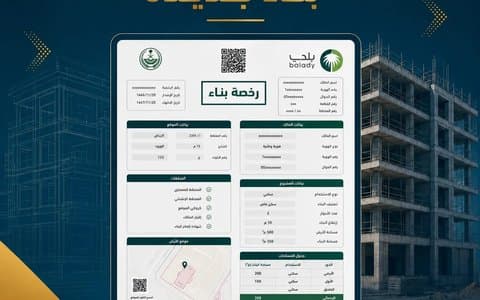

Unfenced vacant land is exposed to dumping, encroachment and random use, and can disfigure the urban landscape on main streets. That is why the Ministry of Municipalities and Housing has paid special attention to fencing vacant land, issued a guide to regulate it, and urged owners to take the initiative in obtaining a fencing permit. This complete guide explains the land fencing permit from every angle.
What Is a Fencing Permit?
A fencing permit is the official authorization to build a fence around a plot according to specific requirements. It is requested through the same Issuing a Building Permit service on the Balady platform, which allows you to apply for either a building permit or a fencing permit; the type is chosen when the application starts.
Why Fence Your Land?
- Protecting the land from dumping, encroachment and use without permission.
- Improving the urban landscape on main streets.
- Compliance when the land lies within an area targeted for fencing.
The Vacant Land Fencing Guide
The Ministry launched a two-phase campaign. The first phase announced the targeted corridors and launched the fencing guide, which contains requirements and design models for fencing vacant land. The guide defines a fence as a series of adjoining barriers of specific designs that separate the land's boundaries from the surrounding sidewalks and streets, and defines vacant land as land that has not been developed for its designated purpose.
Scope: Is Your Land Covered?
According to the published draft guide, fencing applies to land that:
- Lies within the urban boundary.
- Lies on high-density main and arterial roads designated by the municipalities; the guide defines these as roads within the urban boundary that are 40 metres wide or more.
Land frozen by the competent authorities is not required to be fenced until the restriction is lifted. For details: Is fencing vacant land mandatory?
Core Technical Requirements
| Item | Requirement in the published guide |
|---|---|
| Fence position | On the property line, around the entire plot, with a uniform design |
| Height | No less than 1.20 m and no more than 2.0 m |
| Gate | Opens inward and horizontally, at least 2.4 m wide, and kept permanently closed |
| Building inside the plot | Building annexes or any structure is prohibited |
| Rainwater drainage | Fence elements must allow rainwater to drain |
| Safety | Compliance with Chapter 33 of the Saudi General Building Code (SBC 201) |
Among the design models reported in the press coverage of the guide is a fence of steel mesh filled with stones measuring 0.5 × 0.5 m and 0.5 m high. Details in: Land fence requirements: height, materials and gate.
Prohibitions You Should Know
- Using the fenced land for any commercial activity or as a car park.
- Removing or cutting trees on the surrounding sidewalks to build the fence.
- Placing advertising material on the fence without consulting the competent authority.
- Equipment obstructing vehicle traffic during the works.
Owner Responsibilities
- Obtaining the Municipality's approval before construction according to the approved models.
- Removing waste from inside the plot before starting the fencing.
- Protecting the pedestrian sidewalk, lighting and landscaping during the works; violations are subject to the Regulation of Municipal Fines and Penalties.
- Regular maintenance of the fence and repair of damaged sections.
The supervisory authority inspects the sidewalk once the works are complete to make sure there is no damage.
Steps to Obtain a Fencing Permit
- Make sure you have an updated electronic title deed and a valid survey decision. See our survey report service.
- Log in to Balady, choose the Issuing a Building Permit service, then the "fencing permit" type.
- Specify the owner and the applicant, and select the survey decision.
- Select the engineering office and send the application.
- The office prepares the drawing and data according to the requirements.
- Pay the fees, then the permit is issued and printed.
A Fencing Permit Is Not a Building Permit
A fencing permit covers the fence only. The draft guide states that the vacant land fence is to be removed when an activity is established on the land. In other words, when you build you need a separate building permit, and the building's permanent boundary wall is designed as part of your new project.
Fencing Permit FAQs
Where do I apply for a fencing permit?
Through the Issuing a Building Permit service on Balady, by choosing the fencing permit type.
Is fencing mandatory for all land?
No, the scope targets land within the urban boundary on the main and arterial roads designated by the municipalities.
What is the permitted fence height?
Between 1.20 m and 2.0 m according to the published guide.
Can I build a guard room inside the fenced plot?
No, the guide prohibits building annexes or any structure on vacant land.
Can the fenced land be used as a temporary car park?
The draft guide prohibits using it for any commercial activity or as a car park.
Can there be more than one gate?
The draft guide allows one gate, which must not face a commercial road; check the approved version for your municipality.
My land is frozen by a government entity. Must I fence it?
Frozen land is not required to be fenced until the restriction is lifted.
Do I need an engineering office?
Yes, the application goes through an engineering office that prepares the data and the drawing.
Can I put an advertising board on the fence?
Not without consulting the competent department at the Municipality.
Note: the numerical requirements are taken from the guide published on the Istitlaa platform and from press coverage of it; check the approved version on Balady when you apply.
How Abak Engineering Consultancy Helps
Abak is an accredited engineering office in Riyadh that prepares the required drawings and reports, submits the application through Balady and follows it up until issuance. Learn about our land fencing permit service, or contact us to review your case.
For all permit types: The complete guide to building permits in Saudi Arabia.
Regulatory information is based on the Balady platform and the Ministry of Municipalities and Housing, and procedures may be updated by the competent authority. Last reviewed: October 2026.